
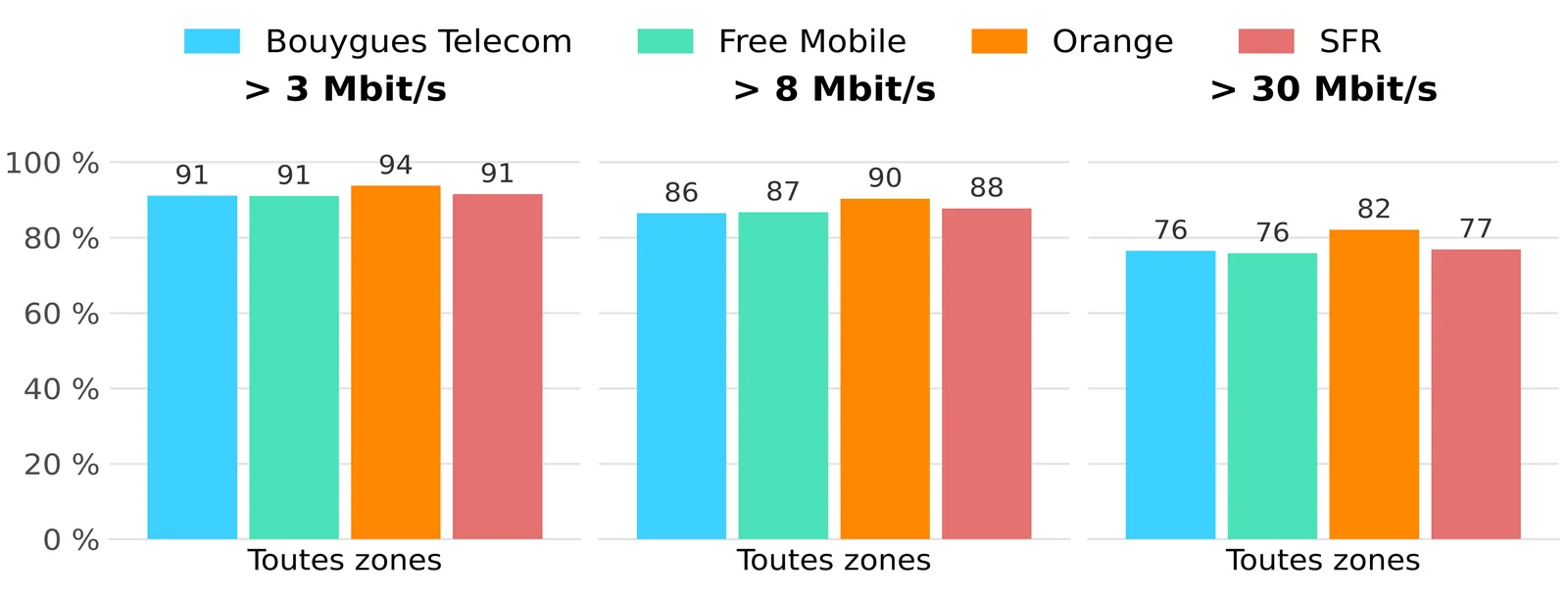
The campaign, based on over one million measurements taken between May and August 2026 across the entire territory, assesses service quality in living areas and during transport. For the first time, Arcep is publishing upstream data rate indicators by thresholds and latency.
Regarding mobile internet, performance is high but more contrasted in rural areas. Across all zones, Orange achieves the best results for downstream data rates, while the other three operators are ex æquo. In dense areas, performance is excellent for common and demanding uses, but rural areas show more significant differences between operators.
Upstream data rates, crucial for artificial intelligence and collaborative uses, are also evaluated. The 1 Mbit/s threshold is met in almost all cases in dense and intermediate zones. For the 3 Mbit/s threshold, Orange and Bouygues Telecom lead across all zones.
Arcep is measuring latency for the first time, a key indicator of network responsiveness. Across all zones and operators, latency is below 50 ms for 82% of measurements, reaching 90% in dense areas and 70% in rural areas.
The quality of web browsing and video streaming is generally fluid, particularly in dense areas. Performance is more contrasted in rural areas, where Orange and Free Mobile stand out for video.
For calls and SMS, nearly 9 out of 10 calls are of perfect quality, with a persistent territorial gap. SMS reception is high-performing for all operators. The quality of OTT voice calls (Over The Top) varies, with Orange and Free Mobile leading.
In mobility, quality is high on roads and in metros. In trains (TGV, Intercités, TER), results are more contrasted, especially for call quality and web browsing, where Orange achieves the best scores.
Arcep makes detailed measurements available in open data on its website and data.gouv.fr, as well as through the 'Mon réseau mobile' tool.