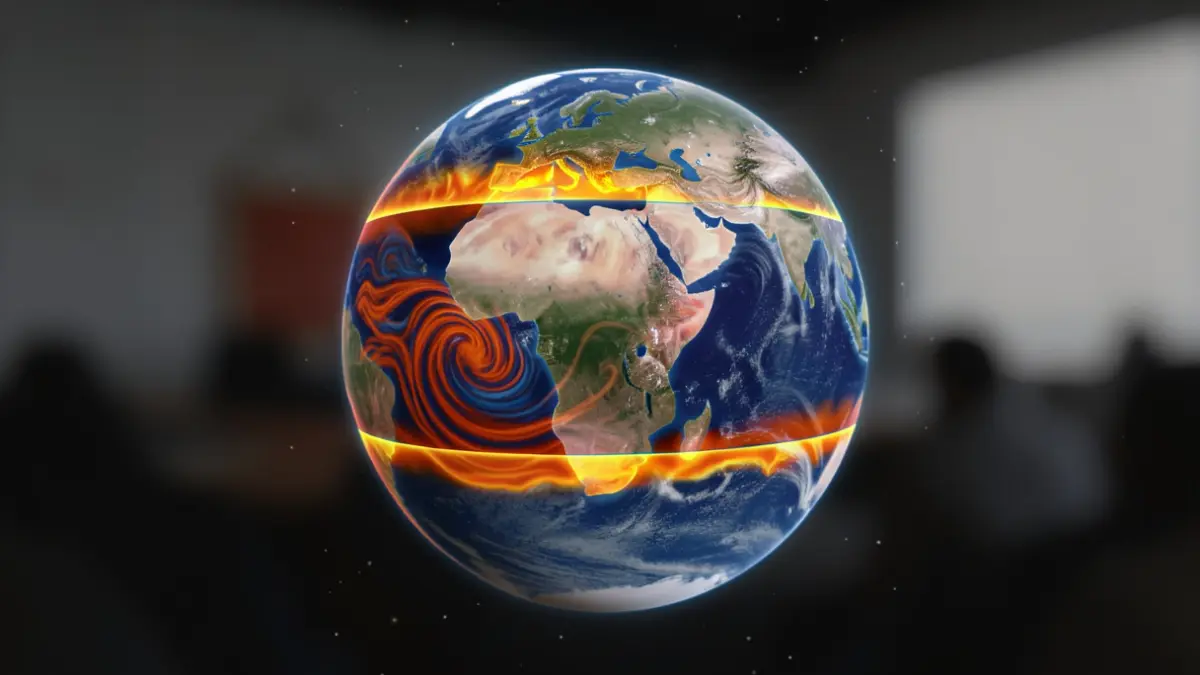
This major advancement, from the GEOAZUR laboratory (Université Côte d’Azur, Observatoire de la Côte d’Azur, IRD, CNRS), links for the first time within a single calculation the dynamics of the Earth's mantle, continental drift, climate, erosion, and sediment transport. Named Pandora, this virtual planet allows us to study how Earth's internal movements influence plate tectonics, landscapes, and climate change on geological timescales.
The simulations reveal that the formation of a supercontinent can lead to global cooling. Tectonic movements move continents towards the equator, lower sea levels, and promote rock weathering, thus consuming atmospheric CO₂. Conversely, the fragmentation of a supercontinent increases volcanic outgassing and sea level, leading to global warming.
These alternations of cold and warm phases emerge from the dynamics of the simulated system, without external perturbation. They show similarities with episodes in Earth's climatic history, particularly after the breakup of Pangaea. Pandora thus opens new perspectives for understanding the relationships between the interior of planets, their surface, and their climate, and could help better understand the evolution of other rocky planets.
This work benefited from the support of the European Research Council (ERC), within the framework of the PANDORA project, funded by the European Union's Horizon Europe research and innovation program.