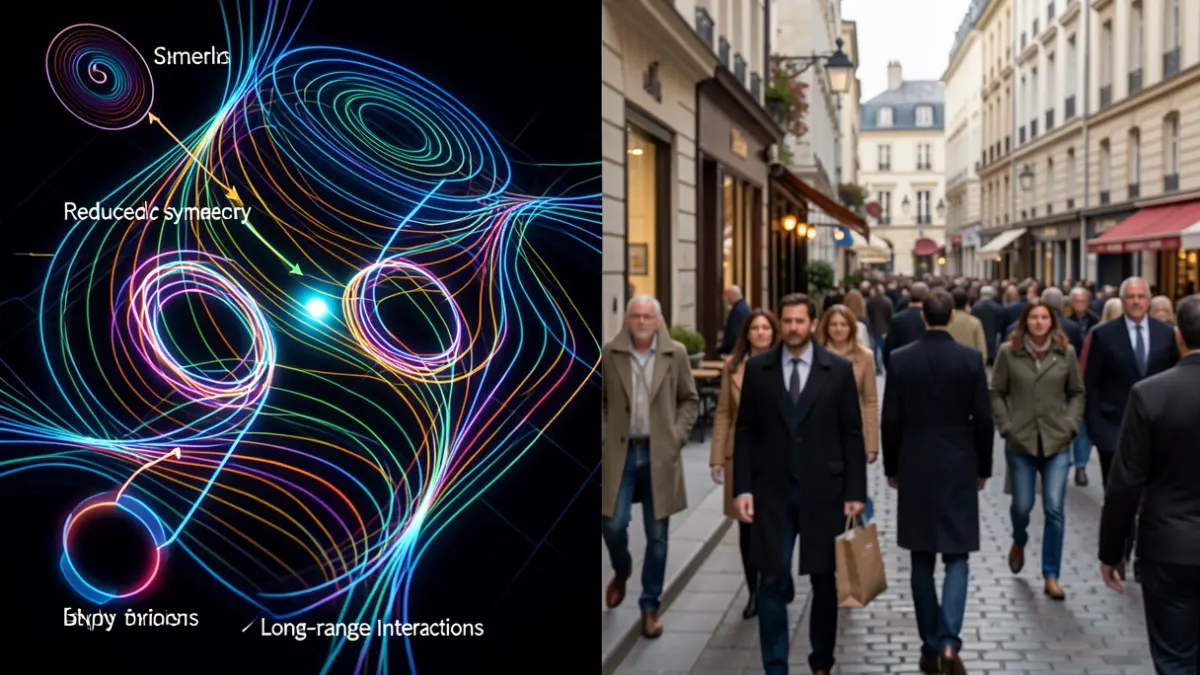
Research on magnetic bimerons, conducted by the MEM group at CEMES-CNRS in collaboration with the University of Kiel, reveals fundamental differences from skyrmions. These structures, characterized by reduced symmetry and soliton interactions, promote the formation of stable network macrostructures. These findings open new avenues for future information storage and processing technologies.
Magnetic skyrmions, vortex-like spin textures with topological charge Q=-1, are of significant interest for spintronic computing architectures. However, their thermal stability is crucial for non-volatile computing, an aspect rarely addressed due to its complexity. No lifetime estimates for bimerons, considered a type of skyrmion, had been previously reported.
Three theoretical studies published in 2026 by these researchers highlight new mechanisms governing the emergence and lifetime of bimerons in 2D materials. Using ab initio calculations and atomistic spin simulations, they predict the coexistence of skyrmions and bimerons, as well as their transformations under a magnetic field in an experimentally realizable van der Waals heterostructure, Fe3GeTe2/Cr2Ge2Te6. They have calculated the lifetimes of bimerons and antibimerons for the first time.
This work challenges the widespread notion that bimerons are simply equivalents of skyrmions. Their reduced spatial symmetry endows them with fundamentally different properties, particularly in terms of spatial localization, entropy-dominated thermal stability, and instanton-like behavior under an applied magnetic field. The research extends to higher-order topological charge bimerons and antibimerons (|Q| > 1), predicting lifetimes up to three orders of magnitude longer.
Together, these three studies form a comprehensive theoretical foundation for bimeron physics, providing deep insights into their emergence, stability, lifetime, and collective behavior. This paves the way for further research and future applications in spintronics, including reservoir computing and neuromorphic computing.