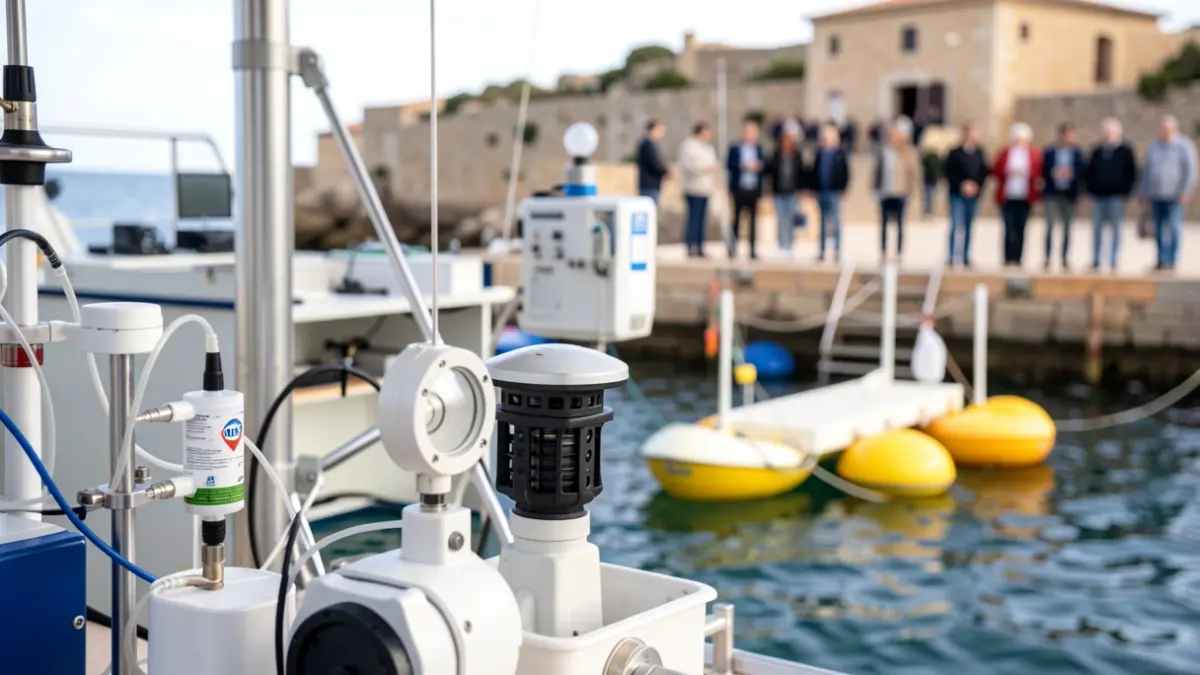
The campaign, which took place in June 2026, marks a significant milestone for the ARISE project and concludes its main experimental phase. These trials aimed to better understand ammonia's behavior during an accidental marine release and to generate experimental data for risk assessment, consequence modeling, detection, monitoring, and emergency preparedness.
A wide range of complementary measurement systems were deployed, including atmospheric detection technologies, infrared imaging, instrumented floating platforms, underwater sensors, mobile and remote monitoring systems, as well as meteorological and oceanographic measurements.
The GARANCe laboratory, affiliated with IMT Mines Alès, contributed its expertise in the experimental study of accidental releases of hazardous substances in the marine environment. The team is involved in the experimental characterization of ammonia releases into seawater to better understand the transfer phenomena between the liquid and atmospheric phases, as well as the physical mechanisms governing their evolution.
“"These works aim to improve the understanding and quantification of the consequences of such accidental releases, by providing experimental data useful for the development and validation of numerical dispersion models that can assess the risks associated with the use of new ship propulsion fuels."
The scientific results from these trials will soon be disseminated in the form of technical reports and scientific publications. Further information about the project is available at https://www.arise-partnership.org/, and a video of the experiment can be viewed at https://www.arise-partnership.org/post/697faff6.