Air updrafts at the heart of thunderstorms play a crucial role in meteorology and climate but remain difficult to measure directly. As part of the preparation for an upcoming CNES space mission, a team from the Laboratory of Aerology at the University of Toulouse (LAERO-OMP, CNRS/IRD/UT) has developed a significant set of realistic thunderstorm simulations. Their study, published on November 11 in the Journal of Geophysical Research : Atmospheres, shows that variations in the amount of ice within clouds can be used to estimate these vertical movements from space.
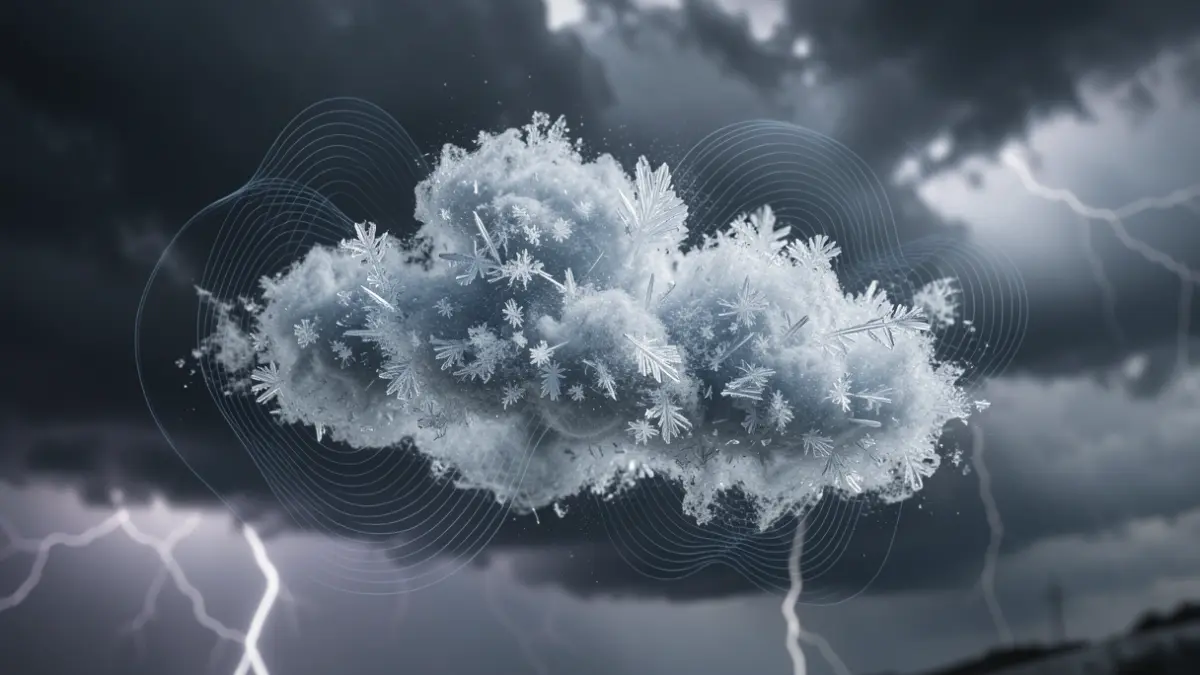
The CNES space mission C2OMODO, scheduled for 2030, aims to estimate these vertical movements using microwave signals sensitive to the presence of ice in clouds, measured at intervals of less than two minutes. When an updraft strengthens, it carries ice upwards. Two very close microwave measurements detect this variation, allowing the air's speed to be deduced. In preparation for this mission, it is necessary to understand how these satellite signals are linked to vertical air movements.
“"Direct observations of vertical velocity within the cores of convective storm systems are rare. Consequently, no large-scale dataset representative of real conditions existed until now."
To fill this gap, the team of scientists created a new dataset, titled MesoNHforC2OMODO RASTA-km. It relies on high-resolution atmospheric simulations, supported by five airborne measurement campaigns during which the RASTA radar observed deep convective systems. This dataset includes approximately 1.2 billion atmospheric profiles from over 50 simulations and has undergone thorough evaluation using radar and satellite observations.
Using this dataset, researchers confirm, on realistic thunderstorms, results previously obtained on idealized cases: variations in the simulated microwave signals for C2OMODO are closely linked to variations in the amount of ice. For developing thunderstorms, these variations also allow for the estimation of updraft intensity.