
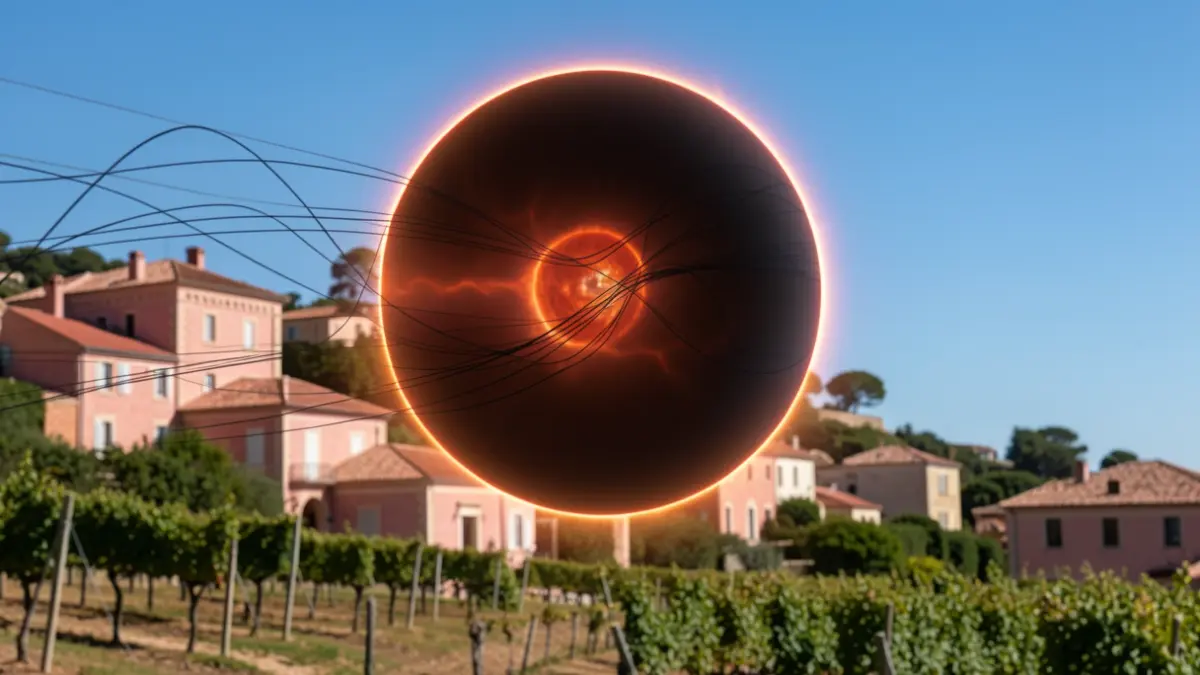
For the first time, an international team led by scientists from the University of Toulouse has attempted to directly detect the magnetic field of an exoplanet. Between September 2025 and July 2026, the SPIRou spectropolarimeter, installed at the Canada-France-Hawaii Telescope, observed the exoplanet KELT-9b, the hottest known, three times as it passed in front of its star. A polarization signal appears to have been detected during the first transit but was absent during the next two. The study, published on October 27 in Astronomy & Astrophysics, deems this evidence fragile but opens the door to a new method for probing the magnetism of distant worlds.
A planet's magnetic field is one of its most fundamental properties, protecting it from stellar winds. While space probes have measured it for planets in the Solar System, only indirect clues like radio emissions were available for the approximately 6,000 known exoplanets. "Yet, there is a way to detect it," explains Alexis Lavail, a postdoctoral researcher at the University of Toulouse, at the Institut de recherche en astrophysique et planétologie (IRAP-OMP, CNES/CNRS/UT) and lead author of the study. Using a spectropolarimeter, the Zeeman effect modifies the light absorbed by atoms, leaving an imprint on the star's spectrum.
This method, used for stars for decades, is more challenging for exoplanets because the light passing through their atmosphere is minuscule. The team chose the most favorable target: KELT-9b, a gas giant nearly three times the mass of Jupiter, located 680 light-years away. Its illuminated side reaches 4,000 degrees Celsius, making its atmosphere electrically conductive and potentially capable of inducing a magnetic field. The planet's infrared spectrum and circular polarization were recorded during three transits on September 7, 2025, and July 3 and 6, 2026.
The signal from September 2025 corresponds to a field of about 2,000 gauss, but no signal was measured in July 2026. "This signal is what we call a candidate. It has withstood several checks, but on its own, it is not robust enough proof," details Alexis Lavail. Scientists are considering either a noise fluctuation or a variation in the magnetic field, which could be unstable in such an atmosphere.
“"It's a situation that is both intriguing and incredibly frustrating"
Future observations will help confirm or rule out this signal. Regardless of the outcome, the method opens a direct window into the magnetism of exoplanets.