On the occasion of COP31, held from November 9 to 20, 2026, in Antalya, Turkey, electrification is highlighted as a major lever for the energy transition. However, simply replacing fossil fuels with electricity is not enough. The challenge lies in ensuring that increasingly interdependent energy networks and technologies can function together effectively, reliably, and at scale. To address these issues, researchers at the Energy, Environment, and Processes Center (CEEP) at Mines Paris – PSL are developing SixGrid, an experimental platform designed to test tomorrow's multi-energy systems before their industrial deployment. Maroun Nemer, Director of CEEP, and Assaad Zoughaib, a professor at the center, are combining their expertise to support the decarbonization of industry, transport, and territories.
The shift to electrification, while crucial for reducing greenhouse gas emissions in sectors like industry, transport, and buildings, raises the complex issue of coordinating different energy sources. Historically managed separately, electricity, heat, cold, and gas networks are becoming increasingly interconnected with the rise of renewable energies and the electrification of industrial processes. The example of an industrial site illustrates this complexity: it may consume electricity, use heat for manufacturing, and potentially recover waste heat for other uses or for a district heating network. Therefore, designing systems capable of producing, converting, and using these different forms of energy in a coordinated manner is essential. The work of Maroun Nemer and Assaad Zoughaib aims to develop methods for better understanding, designing, and managing these complex energy systems, integrating renewable energies, heat recovery, and performance optimization.
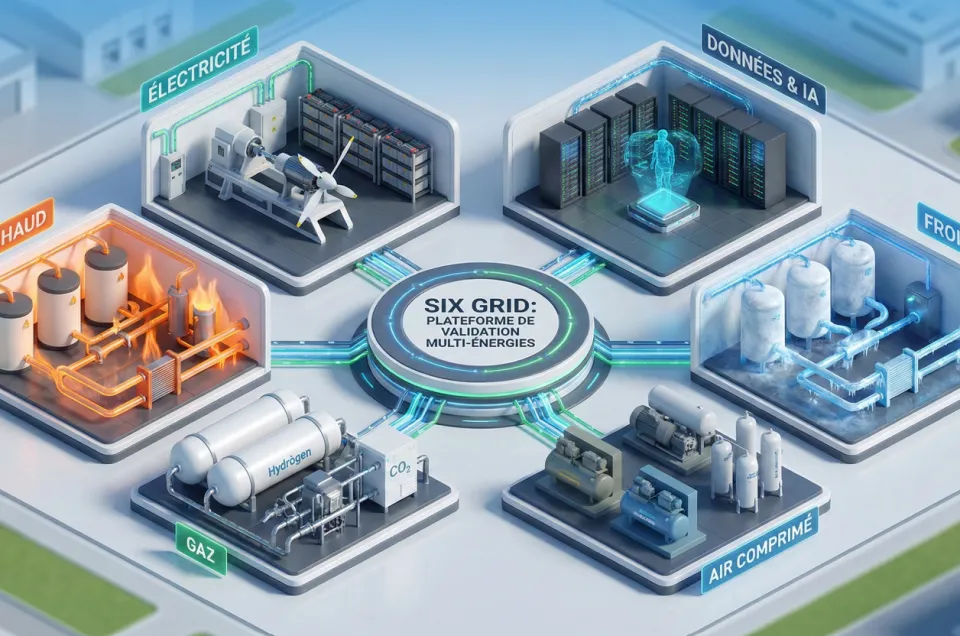
The SixGrid experimental platform, developed by Mines Paris – PSL, aims to bridge the gap between numerical modeling and industrial deployment. It allows for the study of interactions within a complete energy system, rather than testing each component in isolation. SixGrid couples six infrastructures combining electricity, heat, cold, gas, air, and data, with a testing capacity of up to 1 megawatt (MW). Hardware-in-the-Loop (HIL) technology is employed to link real physical equipment with numerical models, simulating the behavior of system components. A sixth network dedicated to data, computation, and artificial intelligence acts as the platform's 'nervous system,' collecting measurements and developing advanced control strategies to anticipate needs and optimize resource balance in real-time. This approach enables the observation of interactions, evaluation of control strategies, and identification of technical difficulties in a controlled environment.
The applications of SixGrid cover several key sectors for decarbonization. In industry, the platform studies the integration of new electrical technologies, waste heat recovery, and energy flexibility, particularly in industrial eco-parks where companies can exchange energy resources. Heavy transport (land, sea, air) and urban networks, with the development of heating and cooling networks, are also major application areas. Artificial intelligence and real-time data analysis are essential for anticipating needs, coordinating equipment, and improving overall energy efficiency, for example, by balancing demand between the electrical and heating networks at the district level.
SixGrid aims to reduce uncertainties for industrialists by allowing multi-energy systems to be tested under near-real conditions, thereby facilitating the transition from research to practical application. This approach reduces technological and industrial risks upstream, which is essential for accelerating innovation. The work at Mines Paris – PSL, through CEEP, leverages expertise in thermodynamics, modeling, and energy integration to make low-carbon technologies function together within reliable, efficient, and flexible energy systems. The goal is to understand how to integrate these technologies into existing infrastructure and optimize their operation at various scales.
As COP31 emphasizes electrification, SixGrid highlights the importance of testing and mastering the interactions of low-carbon solutions before their large-scale deployment. By bringing together scientific research and industrial experimentation, Mines Paris – PSL helps overcome obstacles and prepare the energy systems of tomorrow.