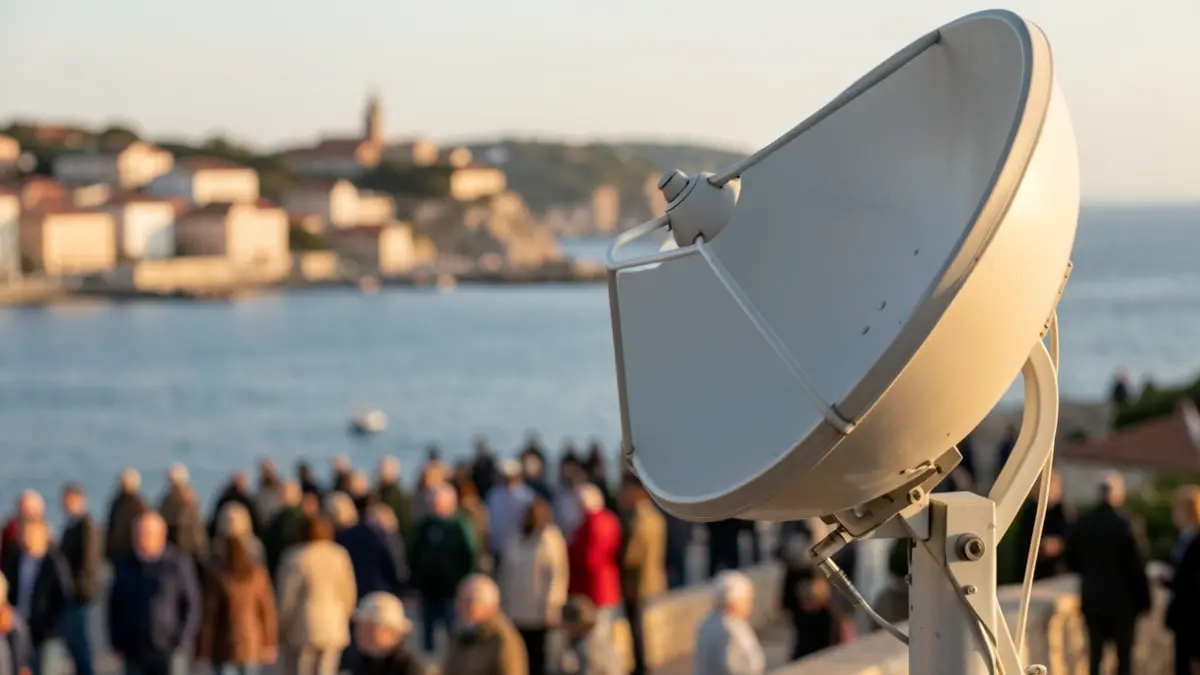
The team at Satlantis France, comprising eight engineers at the Izarbel technology park in Bidart, is a subsidiary of the Spanish company Satlantis, specializing in compact cameras for satellites. Since 2025, the company's image processing center of excellence there analyzes data transmitted by its unique high-resolution spatial polarimetry cameras.
The Aquasat program, supported by the Pays Basque Agglomeration Community, has enabled the foundational steps for monitoring water quality. This innovation detects critical parameters like turbidity, chlorophyll, surface films, and microplastics, which are inaccessible through traditional imaging. "We can observe with greater detail, determine suspended aerosols, and detect pollution sources," explains Julien Chouillou, the team leader.
Research has already led to two scientific publications and the production of certified data for areas including the Adour river, the Bidassoa river, and the Basque coast. The project aims to develop a future camera to improve water quality accuracy and aid in military camouflage. The French National Centre for Space Studies (CNES) is currently reviewing the technical concept for this camera.
Mechanical assembly is planned for Toulouse, while the optical components will be designed and assembled in Bidart, where new engineers will be recruited. Concurrently, the team is working on initial polarimetry learning with Estia.
Recently, the Bidart team witnessed the launch of the Garai-B microsatellite from California and received the Defense & Sovereignty Trophy at the Toulouse Space Forum. The parent company, Satlantis, based near Bilbao, employs 160 staff, with about ten in Bidart, and has agencies in the United States and England. In 2025, its turnover was nearly €48 million.