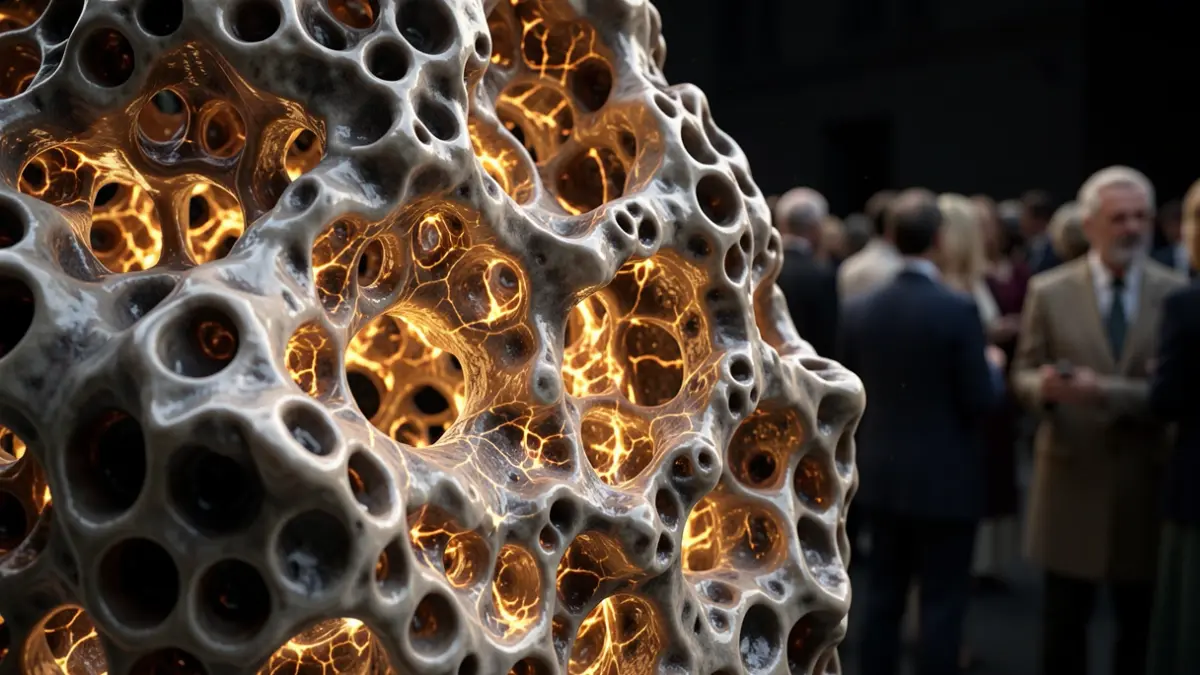
Artificial intelligence is at the heart of two significant advancements in ceramic materials research, as illustrated by two recent publications in the international scientific journals Digital Discovery and ACS Nano. These studies demonstrate AI's potential to advance materials science, through both experimental and theoretical approaches.
The first study, published in Digital Discovery, introduces GEOMIND, a hybrid generative AI designed for the custom design of geopolymers. Unlike traditional methods, GEOMIND reverses the design process: starting from desired performance, the AI proposes suitable chemical formulations. This approach, combining AI and physicochemical laws, promises faster and more reliable discovery of new compositions while reducing experimental trials. The methodology is transferable to other material families. The authors are Sébastien Rousseau, Assil Bouzid, Sylvie ROSSIGNOL, and Ameni GHARZOUNI from the University of Limoges.
The second study, appearing in ACS Nano, utilizes AI and atomistic simulations to understand the internal transformations of ceramics during their manufacturing. Through AI models trained on quantum calculations, researchers have simulated the reorganization of carbon into graphene-like structures within a ceramic matrix. This breakthrough sheds light on the mechanisms governing microstructure formation and paves the way for atomic-scale microstructure engineering to design ceramics with optimized properties. The authors include Fabien Mortier, Sylvian Cadars, Olivier Masson, Mauro Boero, Guido Ori, PhD, Yun Wang, Samuel Bernard, and Assil Bouzid.